Political Correctness by Michael Eric Dyson
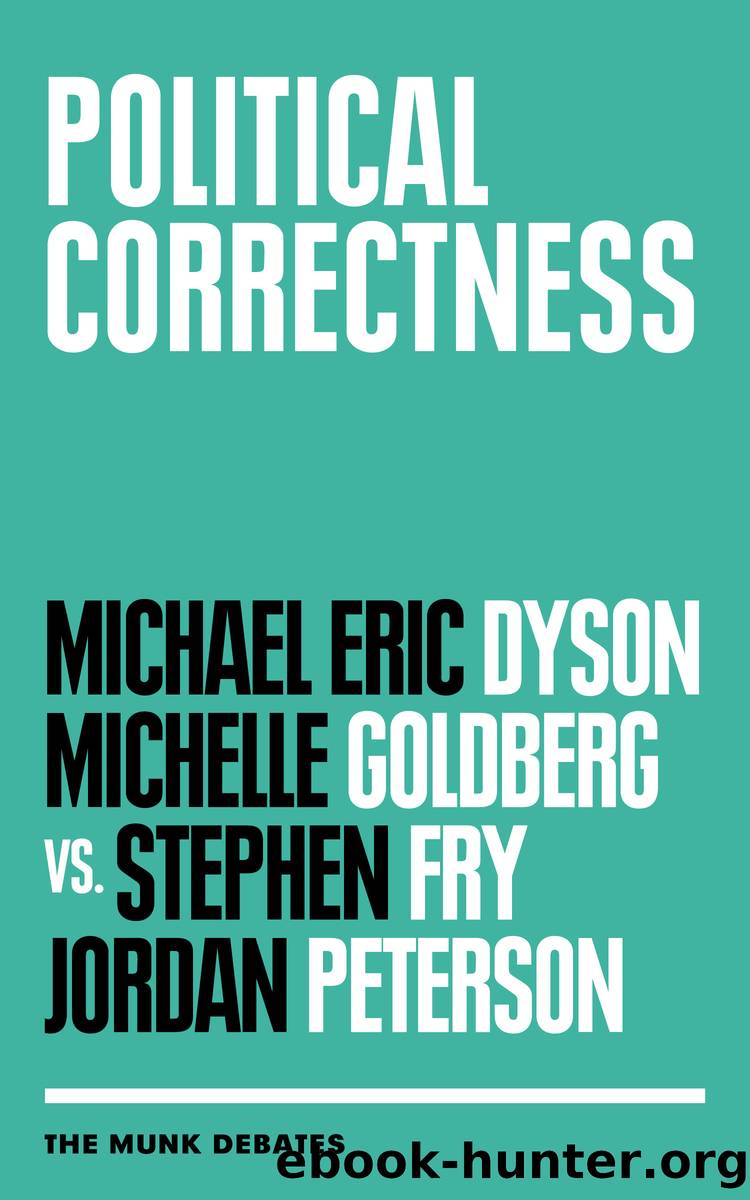
Author:Michael Eric Dyson
Language: eng
Format: epub
Publisher: House of Anansi Press Inc
Published: 2018-10-03T18:58:07+00:00
Post-Debate Interviews with Moderator Rudyard Griffiths
STEPHEN FRY AND JORDAN PETERSON IN CONVERSATION WITH RUDYARD GRIFFITHS
RUDYARD GRIFFITHS: Gentlemen, thank you. We’d like to get your reactions to the debate. We’ll start with you, Jordan. There were some heated moments out there. Did that surprise you, the exchanges that you had with Michael Eric Dyson?
JORDAN PETERSON: Well, I suppose it probably did. It just didn’t seem like a very good tactical move, you know. I stand by what I said: I don’t see any reason at all for my racial identity to be dragged into the discussion, independent of my personality proclivity.
As I just said to Mr. Fry here, it was a pleasure sharing the stage with him. I’ve rarely heard anyone ever deliver their convictions with such a remarkable sense of passion and wit and forbearance and erudition — it was really something.
RUDYARD GRIFFITHS: And Stephen, a challenging debate, because in a sense we were trying to mesh two different world views here, one focused more on identity politics, group identity. You, in a sense, had an argument really more about the larger culture itself and the tenor and tone of the conversation.
STEPHEN FRY: Yes, I worried that I was being a little scattergun really, but scattergun and too specific — that I had just taken very literally the popular idea of political correctness as being a kind of control of language and a shutting down of certain phrases, or an introduction of others. And the kind of day-to-day human resource departments of corporations and that sort of thing. So I was slightly disappointed that it just became a debate about race and about gender and so on. But that was natural, I guess. And the fact is that I’m still a leftie, but a soft one.
RUDYARD GRIFFITHS: You’re not too soft!
STEPHEN FRY: I’m flabby and squashy in every sense. And I realize that that’s not a political point of view; it is a personal one.
RUDYARD GRIFFITHS: Right.
STEPHEN FRY: And the gap between the personal and the political, which is a space you’re obviously very interested in as a psychologist, is one that is rarely explored. People are either so personal that it has no application in the outside world and the organization of human affairs. Or, they’re so political and so focused on structure and the distinction between hierarchies and networks and so on, that they forget the individual. And that’s the space in which the impassioned liberal lives, and it’s not easy to do, because you often do sound rather wet. And I’m aware that I did. But I enjoyed it.
RUDYARD GRIFFITHS: Well, thank you for coming. Just finally, before I free you both to a well-earned drink, is there anything you felt was left unsaid, Jordan? Any point that you wanted to make that you didn’t feel you had the time or the opportunity for?
JORDAN PETERSON: No, I don’t think so. I said my piece.
RUDYARD GRIFFITHS: Same question to you, Stephen?
STEPHEN FRY: No, I think I got everything across.
Download
This site does not store any files on its server. We only index and link to content provided by other sites. Please contact the content providers to delete copyright contents if any and email us, we'll remove relevant links or contents immediately.
| Anthropology | Archaeology |
| Philosophy | Politics & Government |
| Social Sciences | Sociology |
| Women's Studies |
The remains of the day by Kazuo Ishiguro(9016)
Tools of Titans by Timothy Ferriss(8420)
Giovanni's Room by James Baldwin(7365)
The Black Swan by Nassim Nicholas Taleb(7146)
Inner Engineering: A Yogi's Guide to Joy by Sadhguru(6806)
The Way of Zen by Alan W. Watts(6626)
The Power of Now: A Guide to Spiritual Enlightenment by Eckhart Tolle(5804)
Asking the Right Questions: A Guide to Critical Thinking by M. Neil Browne & Stuart M. Keeley(5789)
The Six Wives Of Henry VIII (WOMEN IN HISTORY) by Fraser Antonia(5525)
Astrophysics for People in a Hurry by Neil DeGrasse Tyson(5197)
Housekeeping by Marilynne Robinson(4462)
12 Rules for Life by Jordan B. Peterson(4316)
Double Down (Diary of a Wimpy Kid Book 11) by Jeff Kinney(4286)
Ikigai by Héctor García & Francesc Miralles(4286)
The Ethical Slut by Janet W. Hardy(4271)
Skin in the Game by Nassim Nicholas Taleb(4265)
The Art of Happiness by The Dalai Lama(4140)
Skin in the Game: Hidden Asymmetries in Daily Life by Nassim Nicholas Taleb(4021)
Walking by Henry David Thoreau(3973)
